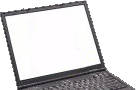
This is a user submitted page about the ins and outs of the Dell Latitude E6500. Here users can provide details about their experiences with this laptop and to provide helpful tips to others. Also available is the discussion section below which can be used to ask questions about the Dell Latitude E6500.
If you would like to edit this page please first view our Editing Guidelines.
For full specifications see the Dell Latitude E6500 specifications page.
| Name | Dell Latitude E6500 |
| Processor | Intel Core 2 Duo P8400 2.26GHz and P9600 2.66GHz |
| Screen | 15.4” WXGA Widescreen and 15.4” WUXGA+ Widescreen (1900×1200) |
| RAM | 1GB and 8GB |
| HDD | 160GB and 64GB High-performance Flash SSD |
| Optical Drive | DVD+-RW and DVD-ROM w/ CD+-RW |
| Graphics | NVIDIA Quadro NVS 160M |
| Network | Ethernet, Intel 5100 802.11abgn, Intel 5300 802.11abgn, Bluetooth, Dell 5720 Sprint Mobile Broadband (EVDO Rev-A) Minicard |
At this stage no one has submitted any notes about the Dell Latitude E6500. If you have any interesting information about this laptop to share please feel free to edit this page and submit what you have.
Discussion
The distros that worked best were always Debian derivatives. Specifically, Mint and PinguyOS (derivative of Mint). I hate reg. Ubuntu, but if you have no imagination or skill, by all means go for it. Maybe it'll work… 64-bit is the way to go for all machines, 2Gb or more. The memory limitation in i386/i686 and PAE mode are a pain.
Other ones that work great for laptops and netbooks are:
PinguyOS & Lubuntu i386/i686 and for my netbook, a Dell 2100
Lubuntu x64 worked great on my Dell E6500 and it has Jupiter!
az